
In the design of an optimal thermal management solution for an electronic system, material selection plays a crucial role, as it strongly influences both performance and overall cost.
The most commonly used materials are copper, aluminium (and its alloys), and stainless steel.
Copper offers the highest thermal conductivity (390–400 W/mK), enabling the best thermal performance. However, it is also the heaviest and most expensive option among the materials considered.
Aluminium alloys, on the other hand, have lower thermal conductivity (150–230 W/mK), but they provide significant advantages in terms of weight and cost. Depending on the alloying elements, they can also offer:
- high extrudability, enabling complex geometries and increased heat exchange surface (especially in air-cooled solutions);
- good corrosion resistance;
- an excellent strength-to-weight ratio, making them suitable for structural support without significantly increasing weight.
Aluminium alloys can be classified based on the production process of the semi-finished product: wrought alloys (rolled or extruded) and cast alloys. The most common wrought alloys belong to series 1xxx (such as 1050), 3xxx, 5xxx, 6xxx (such as 6060), and 8xxx, while typical cast alloys include Al EN AC 46000 and Al EN AC 44300.
In thermal management applications, wrought alloys are generally preferred, as the alloying elements used in cast materials to improve fluidity reduce thermal conductivity by approximately 20–50%.
Many aluminium alloys, such as Al EN AW 6060, 6063, 6101, 3003, and 1050, are also suitable for brazing, enabling the production of complex geometries and leak-tight metallic joints.
Stainless steel, despite its lower thermal conductivity and higher density compared to aluminium, offers excellent mechanical strength and outstanding corrosion resistance. For this reason, it is particularly suitable for aggressive environments.
However, material selection does not depend solely on intrinsic properties, but also on the type of cooling system in which the material is used. Air-cooled and liquid-cooled solutions, in fact, have different requirements.
Air Cooling Solutions
In air cooling, heat is transferred by conduction from the component to the heatsink and then by convection (natural or forced) from the heatsink to the air.
The key parameters to maximise thermal exchange are:
- material thermal conductivity;
- the heat exchange surface area between heatsink and air.
If these were the only criteria, copper would be the ideal material for all air-cooled heatsinks. However, weight and cost constraints make aluminium the most widely used solution, offering an excellent balance between performance, cost, and weight.
In addition, many aluminium alloys (such as 6060 and 6063) are highly extrudable, enabling complex geometries that maximise surface area. This requirement has led to the widespread use of classic finned “comb-like” profiles, as well as custom-designed cross-sections tailored to specific customer needs.
→ Our air cooling thermal solutions
Aluminium heatsinks can also undergo several surface treatments to improve performance:
- Surtec treatment, to enhance corrosion resistance;
- anodising, to increase surface hardness;
- black anodising, to improve radiative heat transfer.
Anodising can also serve a cosmetic function, thanks to the wide range of available finishes.
Copper should not be excluded entirely. In applications with higher thermal demands, copper inserts or base plates are integrated into aluminium heatsinks. In these configurations, copper acts as a heat spreader, improving heat distribution and reducing the formation of hotspots.
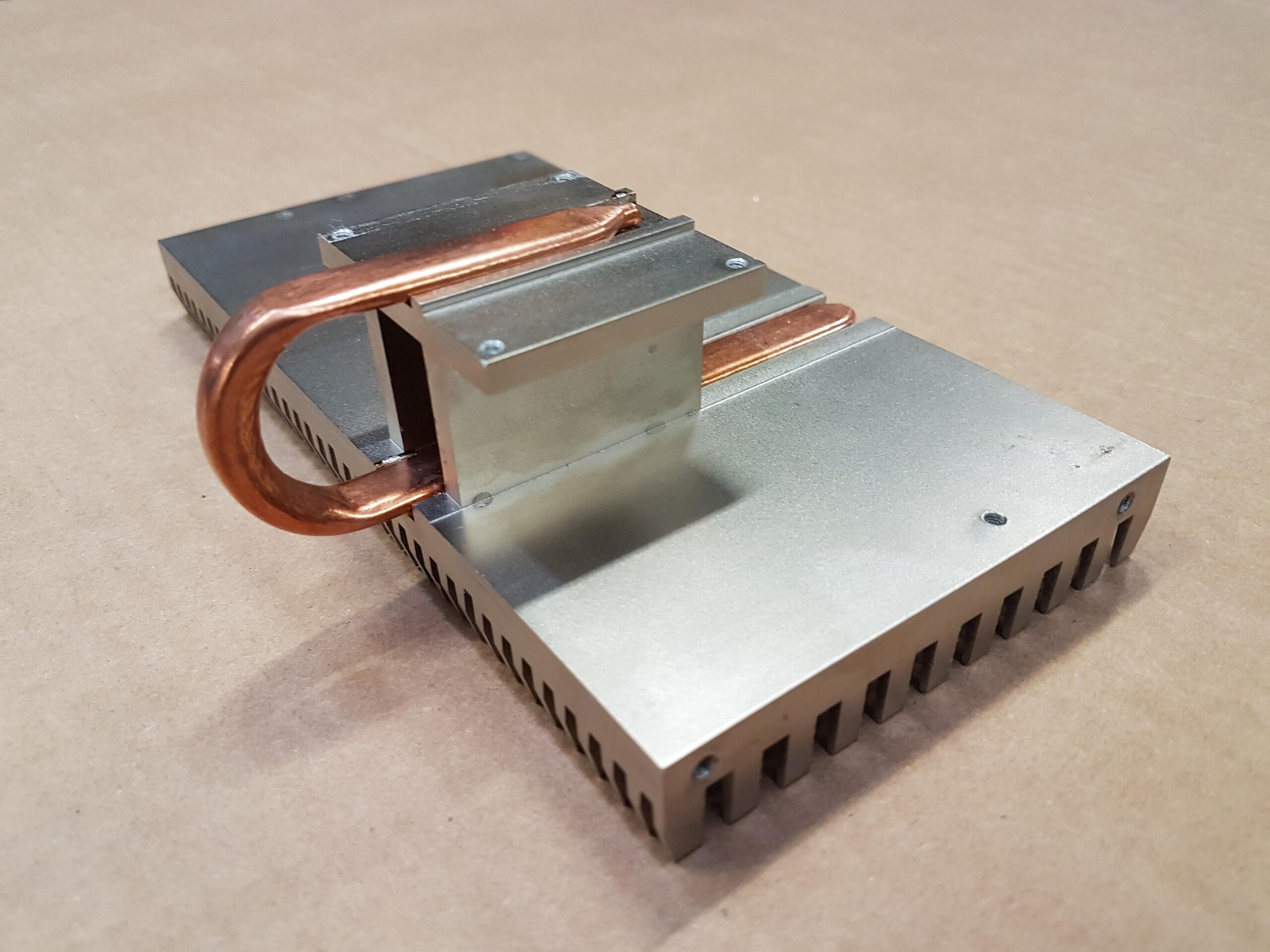
For even higher heat loads, heat pipes are used. These are typically copper components (often cylindrical) that rely on the phase change of an internal working fluid (usually water) to transfer heat more efficiently than conduction alone.
Stainless steel is generally less suitable for air-cooled solutions due to its weight, lower thermal conductivity, and limited extrudability, despite its excellent mechanical and corrosion-resistant properties.
Liquid cooling Solutions
In liquid cooling systems, commonly referred to as cold plates, heat is transferred by conduction from the components to the plate and by convection from the plate to the fluid flowing inside.
Since the thermal capacity of liquids (typically water or water-glycol mixtures) is significantly higher than that of air, material selection is often driven more by chemical compatibility than by thermal conductivity alone, although this remains an important factor.
When using pure water, copper is typically the preferred choice, as aluminium would be subject to corrosion. To reduce material costs, a copper tube can be embedded into an aluminium base plate, allowing the coolant to flow through a serpentine path beneath the components.
→ Our liquid cooling solutions
For aggressive fluids, a similar approach can be adopted using stainless steel tubing combined with an aluminium base. However, this configuration introduces additional thermal interfaces between the plate and the tubing, which can limit overall heat spreading efficiency.
When water-glycol mixtures are used, fully aluminium cold plates become a viable and highly attractive solution. This approach offers several advantages:
- lower raw material cost;
- reduced number of thermal interfaces;
- greater flexibility in channel design and optimisation.
Through brazing processes, it is also possible to integrate turbulators inside the channels, increasing fluid turbulence and improving heat transfer performance.
However, not all aluminium alloys are suitable. For example, Al EN AW 6082, although brazable, tends to form porous joints that are not suitable for the hydraulic sealing and high pressures typically required in cold plate applications.
Aluminium cold plates can also be surface-treated to further enhance performance and durability.
Conclusion
Material selection is a critical aspect of thermal management design, as not all metals are suitable for every application.
A deep understanding of operating conditions is therefore essential to identify not only compatible materials, but also those that optimise performance in terms of both efficiency and cost.
For this reason, Priatherm’s engineering team is always available to support customers in finding the most effective thermal management solution for their specific needs.